

Solutions
FROM METAL-TO-MODEL™
IaaS
Unified infrastructure automation
Multi-Cluster
Hybrid Multicloud
Workload Migration
Virtualization
Private Clouds
GPU PaaS
GPU provisioning & partitioning
AI Cloud
Sovereign Cloud
Enterprise AI Factory
Government AI Factory
CASE STUDY:

Powering Japan’s Clean Energy Future:
How PowerX Deployed k0s Nationwide Across Hundreds of Edge Devices

Image credit: PowerX
The Business
Founded in 2021, PowerX (PowerX Inc.) is a company revolutionizing next-generation energy storage and distribution technology to address global energy challenges. The company develops proprietary energy solutions, including large-scale battery energy storage systems, advanced EV charging infrastructure with integrated battery storage, and the world's first "Battery Tanker”, a vessel that transports electricity directly from offshore wind farms to onshore facilities without the need for expensive submarine cables.
Company
Manufacturer of renewable energy solutions
Tamano City, Okayama, Japan headquarters
Managing Complex, Large-scale Edge Clusters
In 2024-2025, PowerX experienced rapid business growth, including strategic partnerships with global automotive manufacturers, clean energy service providers, and other industry leaders. The company needed to scale operations nationwide, spanning hundreds of distributed electric vehicle charging stations and battery energy storage systems (BESS).
To keep pace with rapid site expansion, the IT team needed to optimize the reliability and scalability of its edge computing infrastructure while keeping costs in check. At the same time, both the engineering and customer success teams required real-time visibility into the state of edge devices in order to maximize system availability.
However, managing a large number of edge nodes was no simple task. The complexity was compounded by the concurrent use of two types of industrial devices with differing specifications: ARMv7 devices with 500MB of memory, and Intel CPU devices with 2GB of memory. All edge nodes need to run IoT gateway software that communicates with microservices running on Google Kubernetes Engine (GKE). The IT team had previously maintained different software versions for each device type, but was looking to transition to a simpler, more automated solution.
Kubernetes at the Edge
The IT team decided to deploy Kubernetes on its edge nodes in order to achieve technology stack alignment with GKE, simplify resource management, and enable consistent deployments via GitOps. Kubernetes adoption also enables improved scalability and reliability, unified visibility across devices, and the application of SRE (Site Reliability Engineering) best practices. By embracing open source technology, PowerX also sought to avoid vendor lock-in.
Selecting a distribution presented several challenges. First, the solution needed to be lightweight enough to run on resource-constrained ARMv7 devices. Additionally, since each node relies on 4G LTE connectivity, a cost-efficient solution that minimizes data transmission costs was essential. Ease of learning, enabling engineers to get up to speed quickly, was also a key consideration.
The company assessed three of the most popular lightweight Kubernetes distributions and chose k0s, a compact and self-contained Kubernetes distribution that is 100% open source. Among the distributions they evaluated, k0s offered the smallest footprint. Packaged as a single binary with no dependencies, k0s was also easier for engineers to deploy.
Hybrid Kubernetes Cluster: Deployment and Observability
PowerX uses a hybrid cluster architecture combining public cloud and edge computing resources. The control plane runs on GKE, while Google Compute Engine (GCE) instances host shared services for security, observability, and other functionalities. The edge devices run k0s agents and join the cluster as worker nodes.
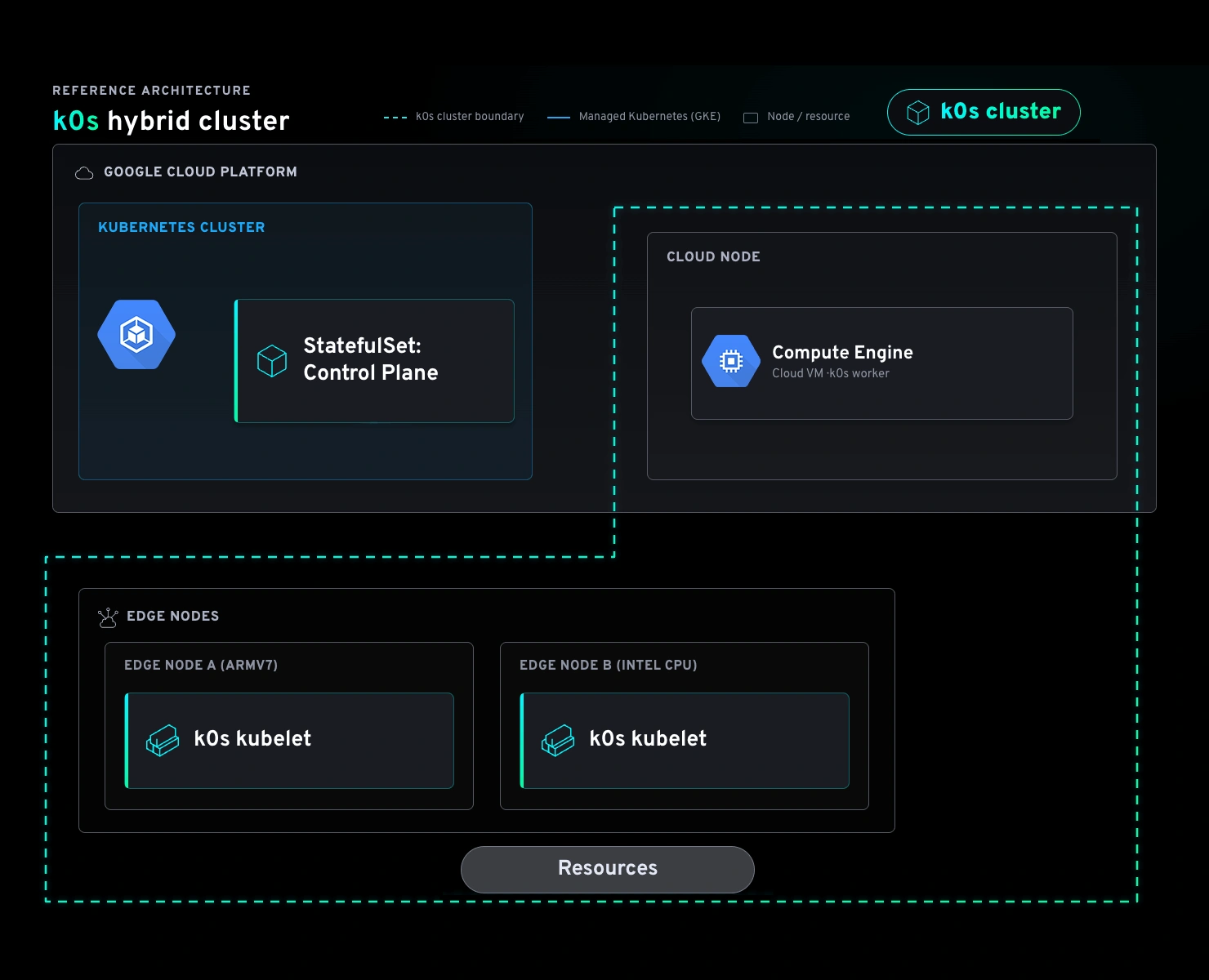
The team uses ArgoCD GitOps to ensure consistent, declarative deployment of Kubernetes resources across all nodes. Kubernetes efficiently deploys the IoT gateway workload to edge devices and controls version compatibility across hardware types. Kubernetes also provides controls to ensure that only edge-appropriate workloads run on the resource-constrained edge devices.
To simplify troubleshooting, the IT team created dashboards for customer success and engineering teams to monitor device performance and the health of charging stations. Based on OpenTelemetry Collector and Prometheus, the dashboards provide cluster-level metrics and unified device-level metrics, despite varying software setup across devices. While the Intel CPU devices run OpenTelemetry Collector directly, the resource-constrained ARMv7 devices connect via VPN to access OpenTelemetry Collector running on GCE.
Consistent and Reliable Edge Computing at Scale
Since adopting k0s on edge devices, PowerX has realized tangible improvements in scalability and reliability. The IT team now runs consistent operations at scale, with hundreds of heterogeneous edge devices efficiently managed via automated GitOps workflows. Running k0s on edge nodes enables secure and stable operations for IoT gateway workloads, even on resource-constrained devices. Reliability improved due to Kubernetes self-healing capabilities, which reduce downtime in case failures occur.
Centralized observability across different devices simplifies monitoring, while combining Kubernetes with Prometheus and OpenTelemetry improves troubleshooting and eliminates the need for custom heartbeat scripts. The cognitive load for engineers has also decreased, thanks to the simple, easy-to-deploy k0s distribution and the unified Kubernetes stack across cloud and edge. Because k0s is open source, costs are also minimized.
Poised for Future Growth
PowerX's rapid nationwide expansion demonstrates how the right technological foundation can accelerate adoption of edge computing solutions. By embracing Kubernetes container orchestration optimized for the edge, the company was able to scale faster and reach more customers, with the agility to deploy seamlessly wherever opportunities emerge.
To learn more about PowerX and their tech stack, watch a recording from SRE NEXT 2025 (in Japanese).
Challenges
Scaling and managing hundreds of heterogeneous edge devices running IoT gateway software.
Complexity of maintaining multiple software versions and ensuring consistent deployments.
Need for reliable, cost-efficient, and observable infrastructure across edge devices.
Solution
k0s provides a minimal, open source Kubernetes distribution that runs on resource-constrained devices.
Hybrid Kubernetes cluster integrates GKE control plane, GCE cloud nodes, and k0s agents on edge devices.
Integrated ArgoCD for GitOps plus Prometheus and OpenTelemetry for consistent deployments, observability, and troubleshooting.
Results
Scalable, reliable operations across hundreds of distributed edge nodes with self-healing and automation.
Improved observability and monitoring with unified dashboards across heterogeneous devices.
Reduced costs and complexity by using a minimal, open source k0s distribution.
Additional Case




900 E Hamilton Avenue
Suite 650
Campbell, CA 95008
+1-650-963-9828